

Just like the co-directors of this event, I am here with a simple mission:
“To normalize failure, not fear it.”
The fear of failure is one of the biggest obstacle we have as a collective. But there’s an irony to it, failure is the best teacher that takes us up a notch. Yet, when opportunities come knocking, we don’t even try out of fear of failure.
But how do we normalize this reality and encourage people to embrace it?
This was the central question that inspired our Professional Development directors, Rtr. Miyuni De Almeida and Rtr. Suvasthiga Suveendran, to organise “Fail Forward Forum”.
They wondered if it would help to show that even the people we look up to, our lecturers, may have failed too.
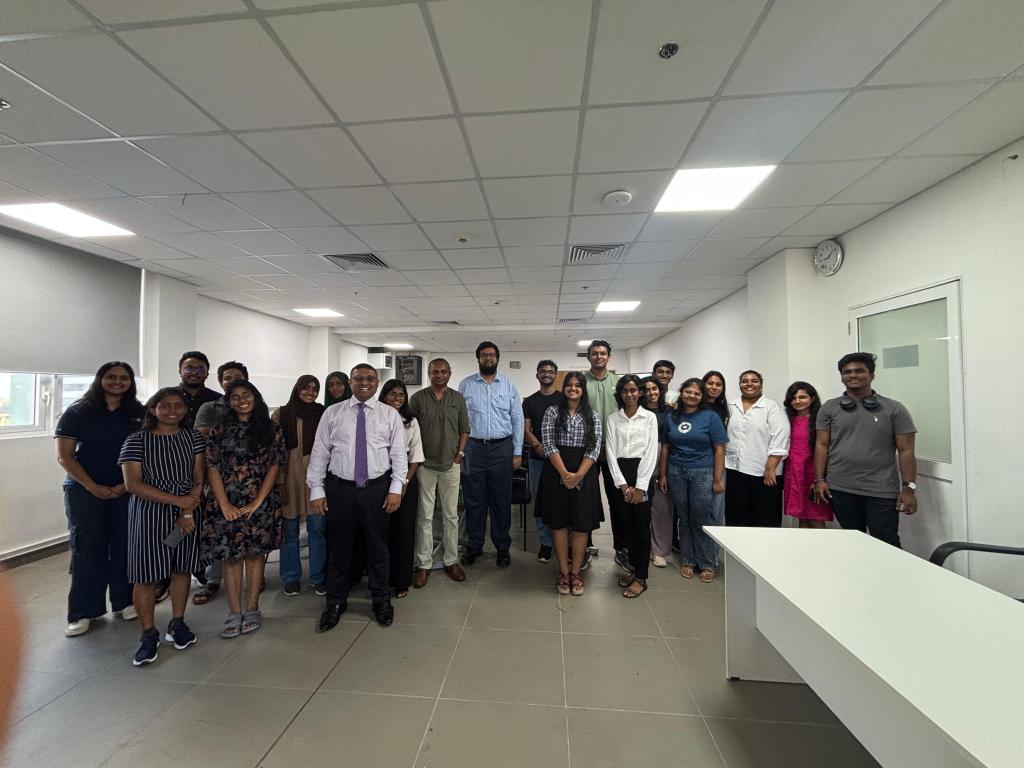
It was an event that signified that failing is indeed a part of success. We get to hear the real stories, the behind the scenes that made our speakers who they are today. It took place on 28th of August in a comfortable, cosy venue in SLIIT where the world’s chatter faded away.
The event marked its beginning as the members of the panel walked in.
The panel for the day included Dr. Nilanga Abeysinghe, Dr. Naren Selvaratnam, Ms Wathsala Ranwala, and Mr Lakmal Ponnamperuma.

Professional Development directors, Rtr Miyuni and Rtr. Suvasthiga kicked off their first event by cutting the ribbon and warmly welcoming the crowd and the panel.
Then the host, Rtr. Miyuni dived straight into the first segment.
Segment 1: FAIL TALE SLAM
This segment was a fun, TEDx-style session where lecturers and speakers shared their failures that taught them more than anyone else could.
Rtr. Miyuni opened the session with an entertaining question:
“What’s the funniest or most random ‘fail’ moment you’ve had, something that seemed big then, but now you laugh about?”
Dr. Nilanga Abeysinghe shared a moment he found quite embarrassing: constantly forgetting a student’s name. One of these moments was recorded and posted on Instagram, where it went viral. He later saw the same student and, this time, remembered their name, which led to a “sequel” video that he joked had restored his dignity.
His advice for these kind of moments is:
“Make mistakes, but make sure it’s a different mistake every time.”
He added that if you don’t dare to take chances, you’ll miss out on opportunities that could change your life, so he encouraged everyone to go around experimenting and find out. Perhaps, you just might succeed.
Next, Ms Wathsala Ranwala recounted a moment at a past job when she mistakenly linked her work email to her personal one and began uploading personal files. The mistake, which could have gotten her fired, seemed like a huge embarassment at the time.
Finally, Dr. Naren Selvaratnam mentioned that his most random fail was scoring a 27 on a test. Fearing his parents’ reaction, he threw the test away and lied, saying he had lost it.
These stories just proves it: we’ve all been there, panicking over a bad grade and doing something we thought was a good idea at the time.
Following up, Rtr. Miyuni asked:
“What’s the most ‘human’ moment you’ve had as a lecturer — maybe a teaching blooper or embarrassing slip in class?”
Dr. Naren Selvaratnam shared his experience of being asked to give a 2-5 hour lecture on a topic that was changed at the last minute. He wasn’t prepared and got so nervous he felt a panic attack crawling thought. He quickly excused himself for five minutes, joking that he had to leave before becoming a “health hazard.”
After the laughter subsided, Rtr. Miyuni continued with a more serious question shifting the energy in the room:
“Students often think lecturers ‘have it all figured out.’ What’s one career or life misstep you made that actually helped you grow as a professional?”
Dr. Nilanga Abeysinghe shared that after graduation, he had two college options but turned down both to travel and start somewhere fresh. This decision led him to a job at a research center in Colombo, which diversified his knowledge and experience. He advised the audience that knowing only one thing will not take you far and urged them to learn different skills, regardless of their degree.
Dr. Naren Selvaratnam recounted how his brother tried to pressure him to change his psychology major to something more “practical.” However, he found any reason to not visit the office and stuck with his choice and ultimately found a job immediately after graduation, while his brother struggled to find one.
Mr. Lakmal Ponnamperuma admitted his favorite subject was political science, but he chose not to pursue it because he found the lecturers to be rude. He believed that, given he was never afraid to speak his mind, he would have been “kicked out.” Adding to that, he spoke about how he used to compare himself to his classmates since he graduated later than them. But later realized that when he got a job in his field, some of those very same people were now reporting to him. His message was clear as daylight: everyone is on their own timeline, and you can’t be too early or too late in life.
Rtr. Miyuni then posed the evening’s most important questions:
“Why do you think failure is such an important teacher in psychology, both as a science and in life? and
Why do you think our culture is so afraid of failure, and how can we change that mindset?”
The panelists offered some eye-opening perspectives:
Ms Wathsala Ranwala says that if you don’t make mistakes, you become a narrow person. She says we are conditioned to perform for other people, but you can never satisfy everyone. So she encouraged the audience to grab opportunities and put themselves out there, as you can’t learn from mistakes you haven’t yet made.
Dr. Nilanga Abeysinghe offered a fascinating perspective on cultural conditioning. He asked the audience to look at the statistics which shows that the most successful people are Jewish. He explained that in our society, we tend to assume mistakes are our fault, while we credit our success to our parents or other factors. This creates a fear of failure. However, in Jewish culture, the opposite is often true: if you fail, the environment is seen as the culprit, but if you succeed, it’s all because of you. This mindset, he argued, is highly effective in moulding successful individuals.
Dr. Naren Selvaratnam reflected on his childhood, where he and his brother sold various items in their neighborhood. The surrounding neighbours often made negative assumptions about them, but he says those experiences taught him a valuable, foundational skill: he is capable of selling anything, anytime so he had the last laugh.
To wrap up the segment, Rtr. Miyuni asked a final, personal question:
“If you could give your younger self a one-line piece of advice before their first big failure, what would it be?”
Dr. Naren Selvaratnam left the audience with a powerful, one-line piece of advice:
“Don’t think about what others think, because they will never stop, and life doesn’t stop for you, so do what you want.”
He concluded by pointing out that if he had listened to his brother’s peer pressure, his life would have ended up being very different.
The session of stories concluded with a fun icebreaker called “Fail Bingo.” This online bingo card featured relatable fails like ghosting a friend or failing a test so if participants had experienced them, they should raise their hands. The atmosphere quickly filled with laughter, perfectly transitioning into the event’s most exciting segment.
Segment 2: LEARN FROM THE L
This session on hypnosis was led by Dr. Naren Selvaratnam, a psychologist and higher education professional with over a decade of experience. At SLIIT-Hemas Allied Health Institute, he has been instrumental in shaping psychology programs and pioneering the institute’s very first psychology lab. Beyond academia, he leads Deep Haven Counseling, where he supports clients and mentors the next generation of psychologists.
Dr. Naren began by debunking the popular myth that hypnosis makes you do weird things, like dancing like a chicken.
He explained that the most important part of the process is letting go. He demonstrated this by first exerting pressure on his seat, then explaining that if he were to let go, his hands would fall to his side and he would simply relax into the chair. He related the hypnotic state to the experience of being so engrossed in a book that you lose track of time.
He then guided the audience through a 15-20 minute session, asking everyone to close their eyes and breathe deeply while his voice echoed, leading them through a forest and down a staircase to a chair where they went deeper into the hypnosis.
Following the session, a participant,
Akshai Retnaraj commented, “I felt really relieved after the session and it was really cool how calm I felt.”
However, not everyone found it easy to let go. Our IT co-director, Muhammadhu Islah, joked that he got hungry from all the energy he put into trying to relax, so it clearly didn’t work for him.
Regardless, it was a unique experience for everyone in attendance.
Unable to top that, Rtr. Miyuni wrapped up the event with a final, powerful message:
“The next time you fail: don’t hide it, don’t fear it. Instead, be courageous enough to fail forward.”
As I come to the end of this blog, I will leave you with a question to ponder:
“What’s one failure that secretly shaped you for the better?”
Penned By:
Rtr. Rana Rilwan
Editor 25-26

 Rotaract Club of SLIIT
Leave a comment