
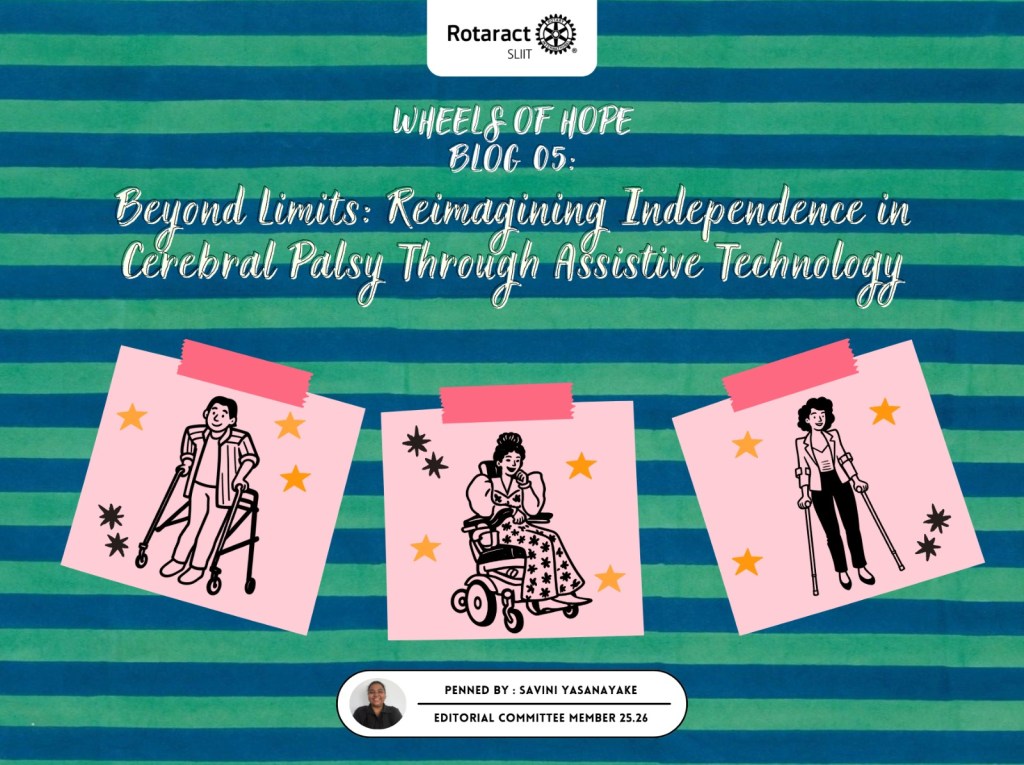
Blog 05
What if independence was never meant to be about doing everything alone?
We often grow up with a very particular idea of what independence looks like: handling things by ourselves, needing less support, relying on no one but our own abilities. It’s a definition that feels simple, even admirable. But it’s also incomplete. Because in reality, none of us live that way.
We rely on systems, tools, and people every single day. Whether it’s technology that simplifies our work, infrastructure that supports our movement, or relationships that help us navigate challenges. Independence has never truly been about isolation. It has always been about having the ability to make choices, to participate, and to live with a sense of control over our own lives.
For individuals with cerebral palsy (CP), this broader understanding of independence becomes even more important. Independence is not the absence of support. It is the presence of choice. And this is where assistive technology steps in – not as a substitute for ability, but as a bridge to it.
Assistive technology is often misunderstood as something purely functional: devices that “help” with movement or communication. But in reality, it is so much more. It is the difference between being spoken for and speaking – between observing life and participating in it.
A speech-generating device or communication app can turn eye movements or small gestures into full sentences – allowing someone to share their thoughts, express emotions, and take part in conversations that matter. A powered wheelchair, controlled by a joystick, head array, or even eye-gaze systems, can transform mobility – turning spaces that once felt limiting into spaces of freedom and exploration. Simple yet powerful tools like adaptive utensils, button hooks, or writing aids can make everyday tasks, eating, dressing, learning, more independent and dignified. And digital assistive technologies, like text-to-speech software, voice recognition, or switch-access systems, allow individuals to engage with education, work, and the world around them on their own terms.
These technologies do not define individuals with CP. They amplify them.
What’s powerful is not just what these tools do, but what they represent. They challenge the idea that there is only one “right” way to move, communicate, or live. They remind us that independence is deeply personal. It looks different for everyone, and that’s exactly how it should be.
For a child with CP, assistive technology might mean answering a question in class using a communication device, participating in activities through switch-adapted tools, or learning through accessible digital platforms. It means being seen not for their limitations, but for their ideas.
For a young adult, it can mean navigating a campus in a powered wheelchair, using speech-to-text software to complete assignments, or independently managing daily routines with adaptive tools. It means stepping into the world with confidence, not hesitation.
And for families, it offers something equally powerful: hope. Not the kind of hope that wishes things were different; but the kind that sees possibility exactly as things are.
Because the truth is, cerebral palsy does not take away a person’s desire to connect, to express, to belong, or to lead a meaningful life. What often stands in the way is not CP itself – but the lack of access, understanding, and support.
Assistive technology begins to change that. It shifts the conversation from “What can’t be done?” to “How can this be done differently?” From limitations to innovation. From dependence to empowered interdependence. And perhaps that’s the most important shift of all.
Because independence has never been about isolation. Humans are not meant to navigate life alone. We all rely on tools, systems, and each other in countless ways, and assistive technology simply makes that interdependence visible, intentional, and empowering.
As we come to the end of this series, we are invited to rethink everything we thought we knew about cerebral palsy. Not as a condition defined by restriction; but as a lived experience shaped by resilience, adaptation, and possibility. Not as a story of “overcoming,” but as a story of redefining.
So maybe the real question is not whether individuals with CP can be independent. Maybe it’s whether we, as a society, are ready to expand our understanding of what independence truly means. Because when we do, we don’t just create better outcomes; we create a world where every voice can be heard, every movement has value, and every person, regardless of how they navigate life, has the freedom to do so with dignity, agency, and hope.
And that is a future worth building.
Penned By:
Rtr. Savini Yasanayake
Editorial Committee Member 25.26

 Rotaract Club of SLIIT
Leave a comment