
Ever notice how there are so many paths to choose from these days? Remote work, freelancing, startups, corporate jobs. Each promises freedom but carries its own risk. You wonder if you are making the right choice. If you are keeping up. If the world is moving faster than you can plan for.
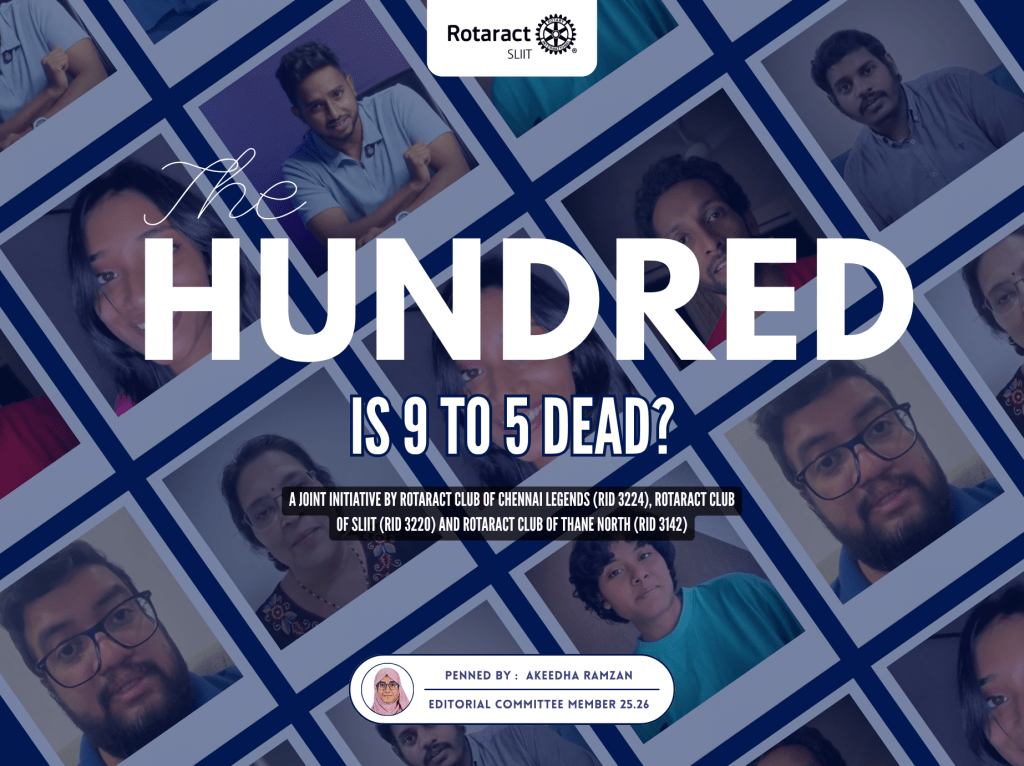
This is the conversation THE HUNDRED, a joint initiative by Rotaract Club of Chennai Legends (RID 3224), Rotaract Club of SLIIT (RID 3220) and Rotaract Club of Thane North (RID 3142), wanted to spark. Through a series of 100-second videos, industry leaders share insights on the changing nature of work.
This year, the focus is on a question many of us have been silently asking: Is the nine-to-five dead? The series does not give one answer. Instead, it encourages reflection and exploration of what work truly means today.
Is the 9-to-5 Dead or Just Different?
Entering the workforce can feel overwhelming. One moment you are juggling tasks. The next, you are scrolling LinkedIn, applying for internships, and realizing everyone has similar CVs. The same skills. The same “passionate and driven individual.”
It starts to feel like a race. A very crowded one.
Somewhere in the middle, the question creeps in. Is the 9-to-5 even worth it anymore?
The truth is it does not feel the same. Jobs no longer end at five. Emails keep coming. Deadlines do not pause for you.
Athithan Kathirgamasegaran points out, “without some form of structure, you won’t have a 9-to-5, you’ll have a 365.”
That hits close to home.
But can we really hate the 9-to-5?
Miyuni De Almeida reminds us, “the 9 to 5 built generations.”
Structure, discipline, stability. There is comfort in a routine, a steady paycheck, and a sense of direction. Freelancing may sound exciting, but it brings uncertainty. “Freedom is beautiful, but freedom also requires discipline,” she adds.
And Then There is AI Changing Everything.
Now the conversation is about more than hours. It is about relevance.
Hisham Hilmy does not sugarcoat it: “If your entire job can be described as a single prompt… you are in trouble.” Automation is reshaping roles. Repetitive tasks are disappearing.
But the human side remains. Creativity, empathy, judgment, the ability to think beyond instructions.
“The future does not belong to those who work the hardest. It belongs to those who work with AI,” he says.
What Actually Matters Now?
If systems handle the technical side, what is left for us?
Being human.
Anderson Kirubaharan captures this perfectly: “only a human can create a real connection with another human.” Communication, collaboration, creativity are skills no machine can replicate.
Saira Kale reminds us: “there is no universal right way to work. It entirely depends on the mission at hand.” Some industries need structure. Others thrive on flexibility. Productivity is measured differently.
Perhaps the goal is not abandoning the 9-to-5 or chasing a 24/7 hustle. Perhaps it is alignment.
Maybe the 9-to-5 is Not the Enemy
For some, it is a starting point.
Naafiah Sariffodeen reflects: “the 9 to 5 was not a limitation. It was a training.” Traditional work shapes discipline, responsibility, and the basics to build on. Not the final destination. But not meaningless either.
Dr. Naren Selvarathnam confirms: “the short answer is no.” The 9-to-5 still exists, sometimes flexible, sometimes rigid, depending on the role.
The 9-to-5 is not dead.
It is just different.
That is both scary and exciting. Multiple paths exist. Multiple definitions of success. We can explore, adapt, and change direction.
As one idea from THE HUNDRED says, “your career isn’t over. It is in beta.” Still evolving. Still figuring itself out. Just like us.
So, the real question is not Is the 9-to-5 dead?
It is: Are we ready to evolve with it?
Penned By:
Rtr. Akeedha Ramzan
Editorial Committee Member 25.26

 Rotaract Club of SLIIT
Leave a comment