
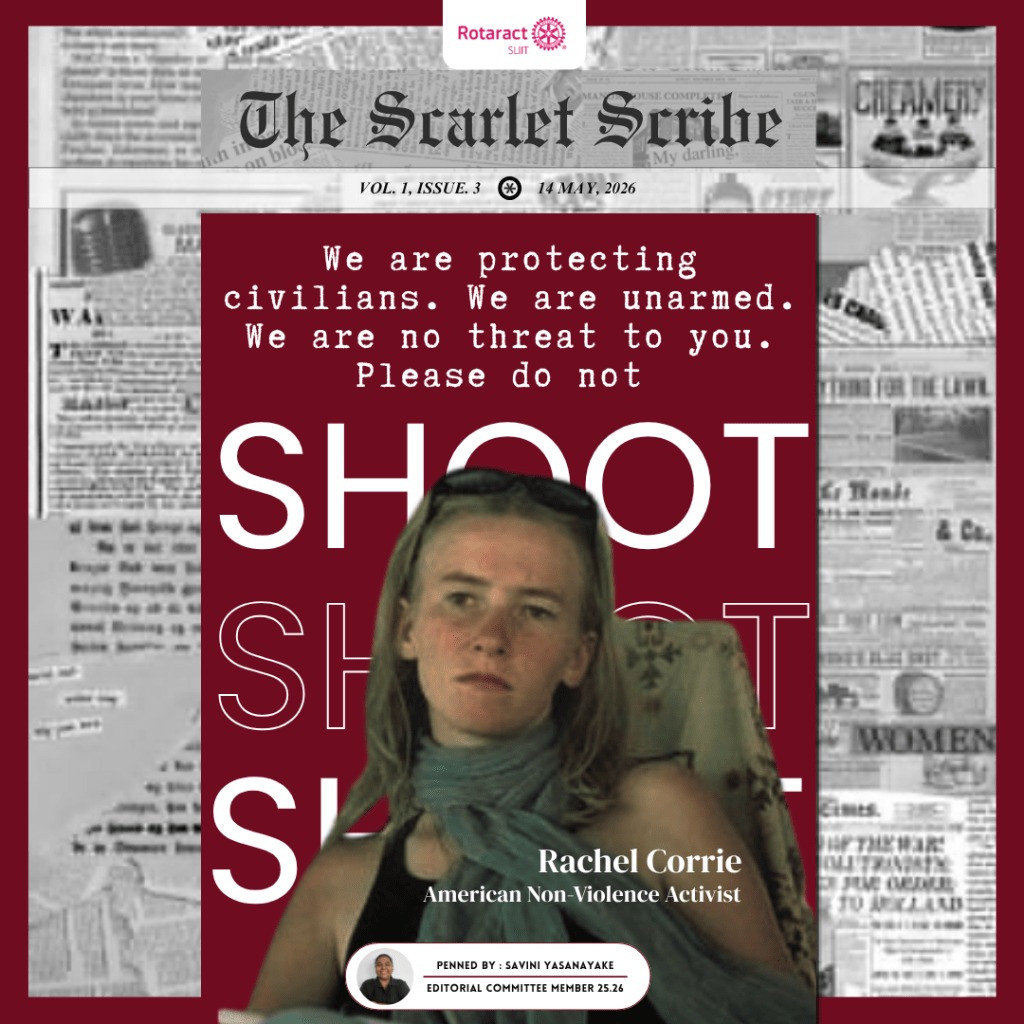
Issue 03
She stood in front of the blade so the world could not look away.
She wanted to be a lawyer, a dancer, an actress, a mother, a poet, a pianist, an astronaut, and the first woman president. She wrote this in a childhood essay, and she meant every word of it – not with the naive optimism, but with the ferocious, wide-open hunger of someone who refused to choose just one part of it to love. Rachel Corrie was born on April 10, 1979, in Olympia, Washington, to a family that raised her to believe that conscience was not a private matter.
She was twenty-three years old when she died. She had been on the ground in Rafah, in the southern Gaza Strip, for less than two months. She had gone not as a soldier, not as a diplomat, and not, strictly speaking, as a journalist – but as a witness. And it is the witnesses, so often, who tell us the truest things.
| HER WORDS PRESERVED
Rachel’s emails and journals were compiled into the play My Name Is Rachel Corrie, compiled by actor Alan Rickman and journalist Katharine Viner, performed to sold-out houses in London’s West End in 2005. Rachel had a writer’s eye and a writer’s compulsion – from Rafah, she sent a stream of emails home: raw, searching, sometimes terrified, always precise. “I have been in Palestine for two weeks and one hour now,” she wrote, “and I still have very few words to describe what I see.” That admission, from someone who always had words, should stop us cold. Gaza had stunned her into silence, and then slowly forced new language out of her.
She wrote about children who had never known a wall without tank-shell holes in it. She wrote about Ali, an eight-year-old killed by an Israeli tank two days before she arrived, whose name the neighbourhood children murmured to her like a password. She wrote about flowers rotting at checkpoints, an entire agricultural economy strangled before it could reach European markets.
“I feel like I’m witnessing the systematic destruction of a people’s ability to survive.”
— Rachel Corrie, email from Rafah, 2003
She was not a neutral observer. She was clear-eyed about that. But she was honest in ways that professional neutrality can sometimes forbid. She did not dress up devastation in passive voice. She named the machines, the soldiers, the families. She described sitting down to dinner with Palestinian neighbours and realizing, mid-meal, that “there is a massive military machine surrounding us, trying to kill the people I’m having dinner with.”
| THE WITNESSES
On the morning of March 16, 2003, Rachel Corrie wore a bright orange fluorescent vest. She and a small group of International Solidarity Movement activists were attempting to disrupt Israeli Defense Forces bulldozer operations in the Rafah district – operations aimed at demolishing Palestinian homes. It was not the first time she had stood between a bulldozer and a house. It had become, for her, a form of testimony: put your body where your words are.
According to eyewitnesses present that day, Rachel climbed onto a mound of rubble being pushed by a Caterpillar D9R armored bulldozer. She was high enough that her head and upper torso were visible above the blade. She was at eye-level with the cab. The driver could see her. The activists nearby waved their arms and shouted. One used a megaphone.
“We ran towards him, and waved our arms and shouted, one activist with a megaphone. But the bulldozer driver continued forward, until Rachel was underneath the cab of the bulldozer.”
– Eyewitness account, March 16, 2003
She was taken by Red Crescent ambulance to Najar Hospital in Rafah, arriving at 5:05 pm, she did not survive. The world would argue about what happened on that road for decades. The Israeli military called it a tragic accident. Eyewitnesses, including her fellow ISM activists, said otherwise. The family pursued legal action in Israeli courts for years. In 2012, an Israeli judge dismissed the case, ruling the state bore no responsibility. The Corrie family rejected that verdict. Much of the world did too.
| THE LEGACY
What Rachel Corrie left behind is a body of writing that refuses to age. Her letters from Gaza were published in 2008 under the title Let Me Stand Alone. Yale Professor David Bromwich described them as “letters of great interest.” That is, perhaps, an understatement of historic proportions. They are letters of grief, of outrage, of love, of desperate moral clarity. They are the letters of someone who understood – as few of us allow ourselves to – that injustice anywhere requires a witness everywhere.
“I really can’t believe that something like this can happen in the world without a bigger outcry. It really hurts me, again, like it has hurt me in the past, to witness how awful we can allow the world to be.”
– Rachel Corrie, email from Rafah, 2003
Palestinian Authority President Yasser Arafat told Rachel’s father: “She is your daughter, but she is also the daughter of all Palestinians.” Streets were named for her. The Rachel Corrie Foundation for Peace and Justice was established in her memory. A cantata was composed in her honour. A cargo ship bearing her name sailed toward Gaza in 2010 as part of a humanitarian flotilla.
Her name became a symbol, which is both the most and the least a name can do. Because symbols are clean, and Rachel Corrie was not – she was a young woman who had nightmares about tanks outside her childhood home, who worried that her protests were too small, who missed her family. She was entirely human. And she chose, knowing the risk, to stand in the path of something massive and say: not this house. Not today. Not while I am here.
We know she was there. We know she was wearing orange so no one could miss her. We know she believed that visibility was itself a form of protection – that if the world could see, it might be moved to act. She was twenty-three years old and she staked her life on that belief.
Rachel Corrie believed that. She still does, somewhere in every sentence she left behind.
“I’m here because I care. I’m here because children everywhere are suffering.”
– Rachel Corrie
Penned By:
Rtr. Savini Yasanayake
Editorial Committee Member 25.26


Leave a comment