
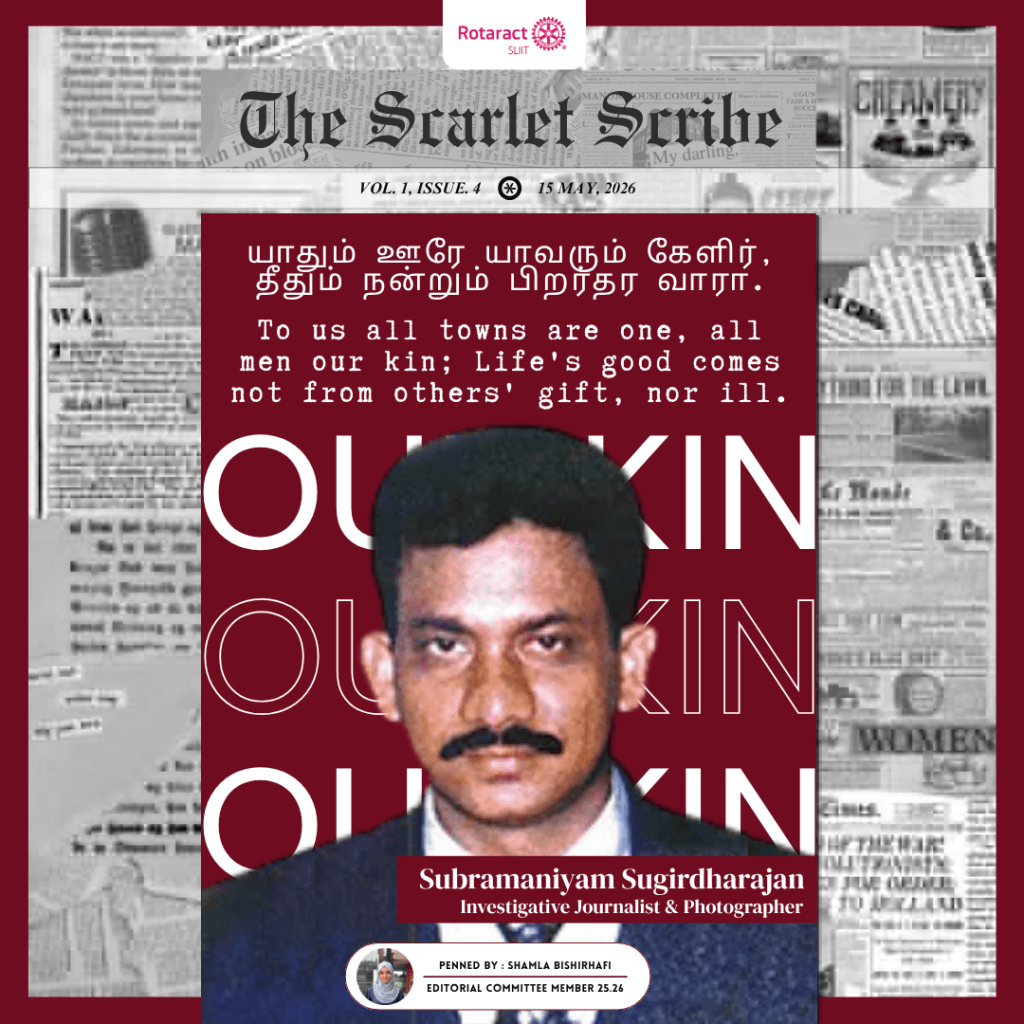
Issue 04
He was a witness to injustice, and his pursuit of truth would cost him everything.
They say that to be a journalist is to see what others overlook. And in a time of conflict, the most dangerous thing to carry isn’t only a weapon, it could also be a camera. For Subramaniyam Sugirdharajan, being a journalist meant being the voice for the truth in a place where silence was the only way to stay safe. His life stands as a symbol of the belief that truth is not simply told but protected.
Subramaniyam Sugirdharajan, often referred to as SSR, was an established correspondent for the Tamil- language daily newspaper Sudar Oli. His work primarily covered the area of Trincomalee, in the Eastern region of Sri Lanka, where he focused on human rights, corruption, and the impact of the civil war on civilians.
What made Sugirdharajan so remarkable was that he wasn’t just an outsider observing events unfold, but a journalist who lived among the people whose stories he told. He lived in the same neighbourhood he wrote about, and his own children walked the same streets as the families he interviewed. When he wrote for the Sudar Oli, he was writing about his own community. His work didn’t just focus on the big headlines but rather in consistently documenting the smaller struggles that people faced every day. Because every struggle is worth talking about.
Sugirdharajan was known to be a reporter who often pursued stories that others were too afraid to touch and in this very pursuit he would uncover details to an incident that would change his life forever.
His career reached a significant point in January 2006. When a tragic accident involving five local students had been labelled as a grenade accident, Sugirdharajan being the fearless reporter that he was took his chances and went looking for an explanation. He didn’t wait for permission. He entered spaces that no one else would dare to, including the mortuary, to make sure that evidence matched the official explanations. His refusal to sit back and watch would ultimately make him a target and in the morning of January 24, 2006, he was assassinated while
waiting for his bus. He was thirty-five years old. Twenty years later, his case remain unsolved. Failing to punish crimes against journalists creates a culture where no one is held responsible.
Subramaniyam Sugirdharajan didn’t just sit behind a desk, he walked alongside others, existing as the voice of the ordinary people of Trincomalee. He was respected because he wasn’t simply reporting, he was standing up for the people, taking risks that no one would dare to, constantly running to expose the truth buried under the lies that were easier to print on paper. And he did all this with proof, it was never just about writing stories for Sugirdharajan, it was about being the voice of those who didn’t have the power (the privilege, the freedom) to be loud.
Subramaniyam Sugirdharajan showed that being a journalist isn’t just about carrying a camera and writing good stories, rather it is about having the courage to always stand by the truth. The photographs he captured costed him his life but until his last moments he made sure that the
truth wasn’t covered up.
He proved that being a journalist isn’t only about writing stories, it is a heavy weight to carry. Journalists bear the scars of the stories they witness, etching them into their words and their lens.
Penned By:
Rtr. Shamla Bishirhafi
Editorial Committee Member 25.26


Leave a comment