
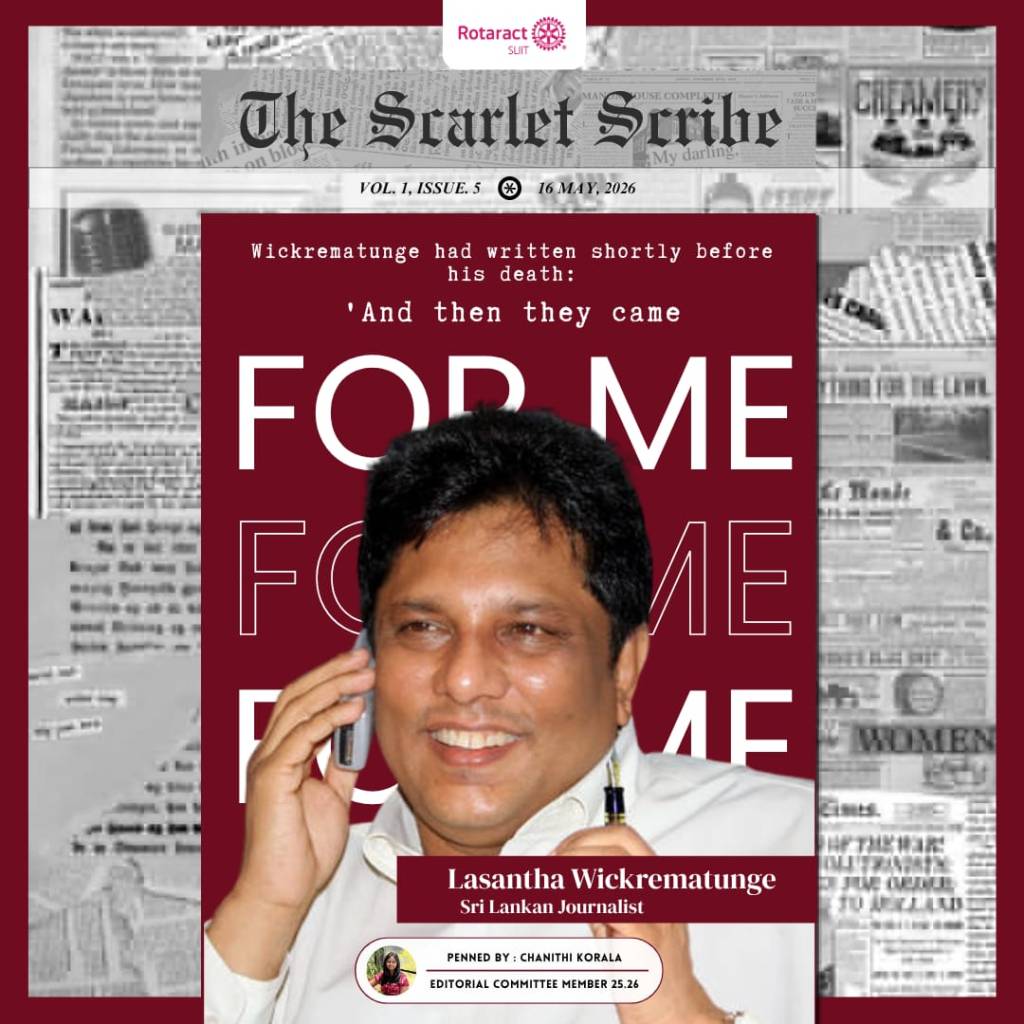
Issue 05
Some journalists report what happens. Others make sure the truth is not buried beneath fear.
Lasantha Wickrematunge was one of those journalists. As the founder and Chief Editor of The Sunday Leader, he became known for journalism that asked difficult questions at a time when asking them was not always safe. He was also a lawyer, a writer, and a public figure whose work often focused on corruption, abuse of authority, and human rights concerns in Sri Lanka.
Amnesty International noted that The Sunday Leader had published articles on political interference, corruption in privatization deals, and human rights abuses during the period of intensified conflict in the country.
His journalism was not quiet journalism. It did not exist only to fill pages or repeat what had already been said. His work carried the belief that citizens deserved to know what was happening around them, especially when the truth was uncomfortable. At a time when many voices were becoming cautious, The Sunday Leader remained known for challenging silence.
On January 8, 2009, Lasantha Wickrematunge was killed while travelling to work. The news quickly became one of Sri Lanka’s most widely reported press-freedom stories, appearing in both local and international media. The Guardian reported it with the headline “Sri Lankan newspaper editor shot dead,” while Amnesty International also reported the news under the headline “Sri Lanka: Newspaper editor shot dead.”
But the headline alone could not hold the full weight of what his death meant.
To the public, this was not simply the death of one editor. It raised a larger fear: if a journalist as recognized as Lasantha could be silenced, what would happen to smaller voices? What would happen to ordinary citizens whose stories depended on journalists brave enough to investigate them? Amnesty International warned at the time that journalists in Sri Lanka were increasingly afraid to express alternative views, and that threats against independent journalists had pushed some to leave the country.
That is where this story becomes bigger than one newsroom. Journalism is not only for journalists. It belongs to the public. When journalists are pressured into silence, citizens lose access to questions that should be asked on their behalf. They lose investigations into corruption. They lose stories that challenge official comfort. They lose part of their right to understand the world they live in.
What made Lasantha’s story even more haunting was the editorial he left behind. Published after his death, it became one of the most remembered pieces in Sri Lankan journalism. UNESCO later described the article as a reflection of his “commitment and fierce independence,” noting that it was written for posthumous publication and first published in The Sunday Leader three days after his death.
In that final piece, Lasantha did not only write about himself. He wrote about journalism, fear, and the responsibility of the press. He seemed to understand that the work of a journalist could outlive the journalist. That is why his legacy cannot be measured only by the way his life ended, but by the questions his work continued to leave behind.
Lasantha Wickrematunge should be remembered not only as a man who became a headline, but as an editor who understood the cost of truth. He showed that journalism is not always about being popular, safe, or agreeable. Sometimes it is about standing in the uncomfortable space between power and the people.
Years later, his name remains part of Sri Lanka’s wider conversation on press freedom and justice. The Committee to Protect Journalists has continued to refer to his case when discussing unresolved attacks against journalists in the country.
And perhaps that is why his story still feels unfinished.
Because when a journalist spends his life asking difficult questions, and his own story leaves so many unanswered, what does that say about the truth he was trying to protect?
Penned By:
Rtr. Chanithi Korala
Editorial Committee Member 25.26


Leave a comment