
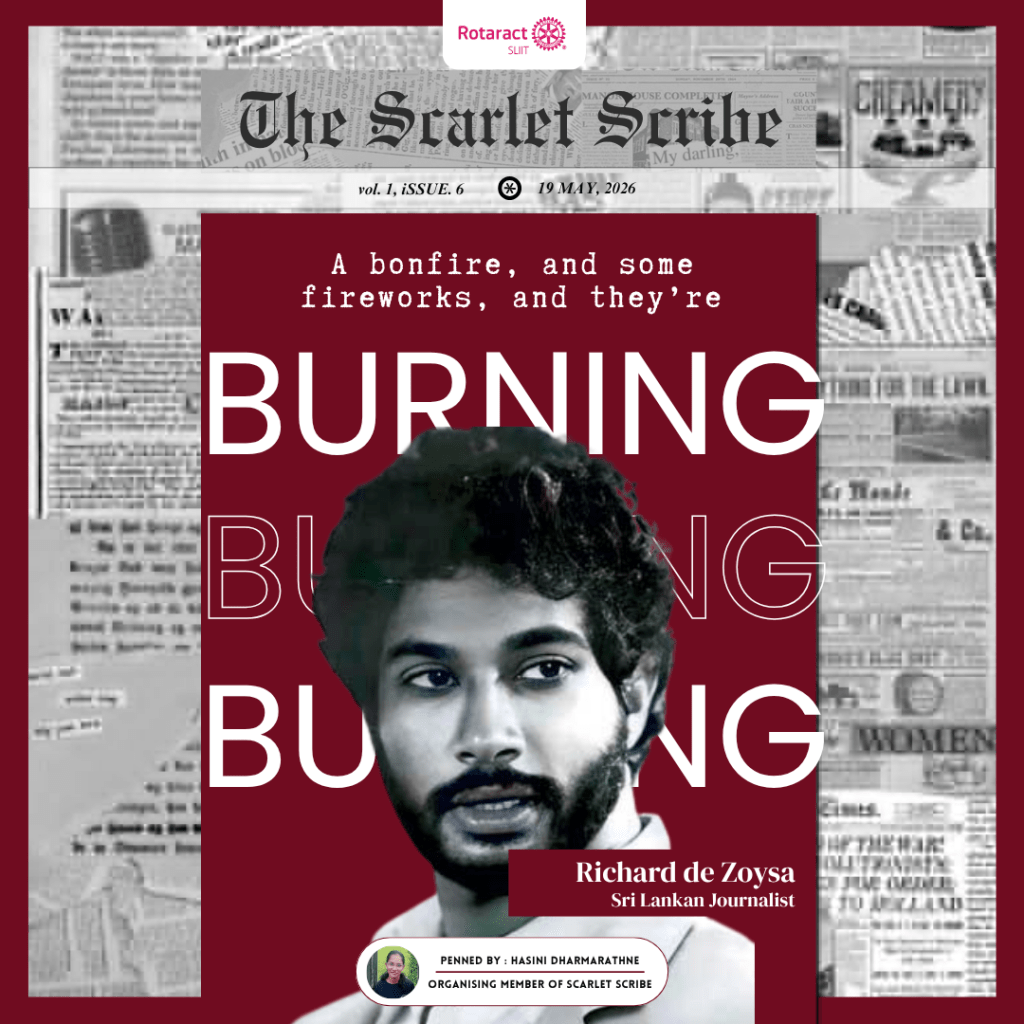
Issue 06
There are periods in history where silence becomes a form of survival. Doors closed earlier. Conversations softened into whispers. People learned not to ask too many questions, and certainly not in public. Sri Lanka in the late 1980s was one of those places. Fear moved quietly, but it moved everywhere.
And yet, even in times like these, there are always people who continue to speak.
Richard de Zoysa was one of them.
He was not only a journalist. He was also an actor, a writer, and a human rights activist, someone who moved between art and politics with unusual ease. Those who knew him often spoke of his intelligence, his eloquence, and the sharp clarity with which he understood the world around him. He belonged to a generation of Sri Lankans forced to live through violence that often arrived without warning and disappeared without explanation.
But Richard de Zoysa refused to look away from what was happening around him. At a time when fear shaped ordinary life, he continued speaking about abductions, disappearances, and abuses of power. Through his journalism and activism, he drew attention to the growing violence that had settled over the country during the period of political unrest. It was dangerous work precisely because it challenged silence, and silence had become deeply valuable to those in power.
He understood something many journalists eventually learn: that truth is rarely dangerous on its own. What makes it dangerous is who it threatens.
Richard worked with both local and international media, bringing attention to stories many would rather leave undocumented. He spoke openly about human rights violations during a time when doing so carried consequences. Around him, people learned to lower their voices. Some stopped speaking entirely. Richard de Zoysa did not.
He wrote during a time when the night itself seemed to carry fear. Families waited for loved ones to return home. Names disappeared from newspapers as suddenly as people disappeared from the streets. Survival often depended on knowing when not to ask questions. But journalism, at its best, asks questions anyway.
On the night of February 18, 1990, armed men arrived at Richard de Zoysa’s home and took him away. His mother watched it happen, a moment of terror carried out within the walls of an ordinary home, the kind of place that is supposed to promise safety. Less than a day later, his body was found along the coast south of Colombo. And just like that, a 31-year-old was silenced simply for choosing to stand up for the truth, which many refused to do.
His death sent shockwaves through Sri Lanka’s media and human rights communities. For many, it confirmed what they had already feared: that truth itself had become something punishable.
But Richard de Zoysa’s story did not disappear with him.
Over the years, his name became tied to larger conversations about press freedom, state violence, and accountability in Sri Lanka. Journalists, activists, and writers continued to remember him not only because of the way he died, but because of the courage with which he lived. He represented a kind of journalism that refused comfort. Journalism that understood witnessing as a responsibility rather than a profession.
Yet, there is something unsettling about revisiting stories like his decades later. Not because they belong entirely to the past, but because they continue to ask uncomfortable questions about the present. What happens to a society that teaches its people to fear speaking openly? What happens when silence becomes ordinary?
Richard de Zoysa understood that silence protects power far more often than it protects people. His legacy is absolutely inspiring for generations to come.
And perhaps that is why his story still remains. Not simply as memory, but as a reminder of what it once meant, and still means, to speak in dangerous times.
Penned By:
Rtr. Hasini Dharmarathne
Organising Member of Scarlet Scribe


Leave a comment