
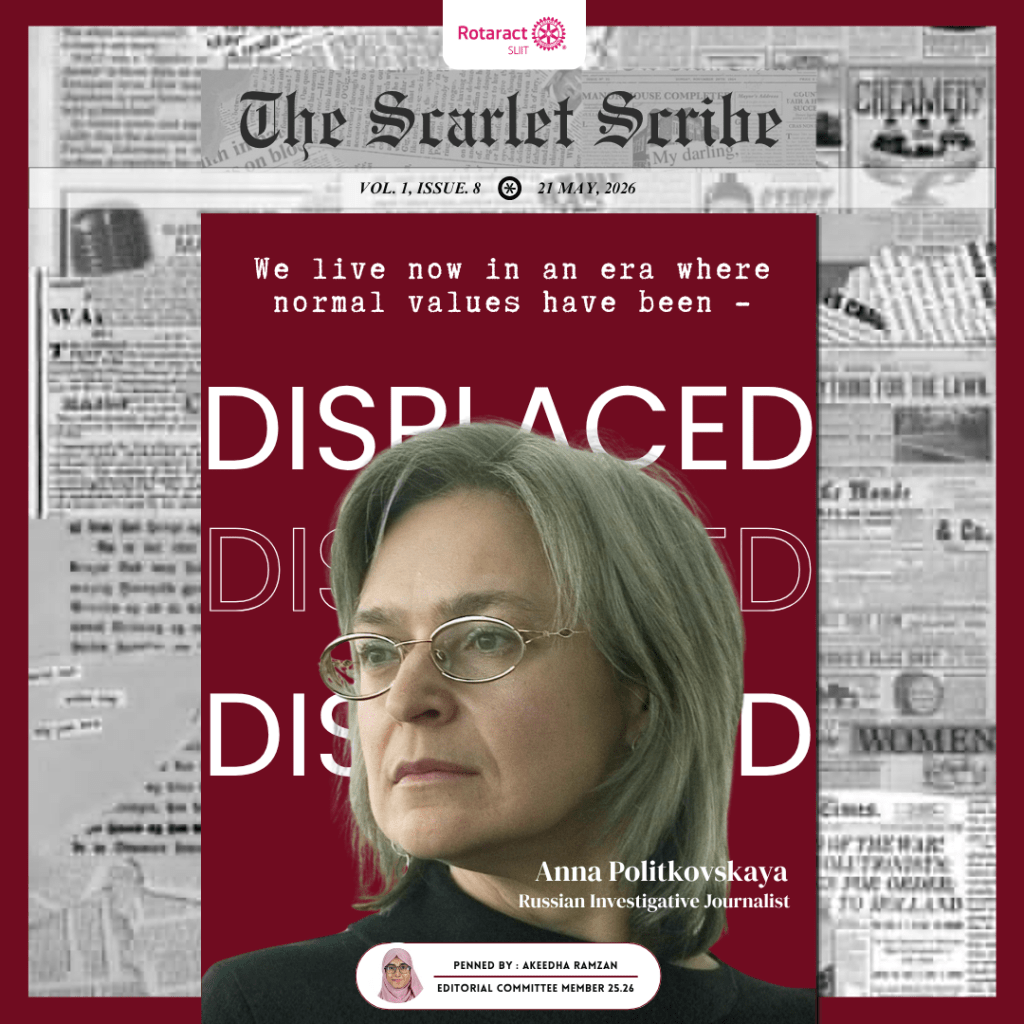
Issue 08
Some stories do not disappear because they are finished.
They disappear because someone powerful benefits when people stop asking about them. A war becomes too complicated to follow. A country feels too far away. A journalist’s name appears once, then fades into the background of everything else happening in the world.
Anna Politkovskaya spent her life refusing to let that happen.
She was a Russian journalist and writer who reported for Novaya Gazeta, one of Russia’s few independent newspapers. She was born on 30 August 1958 in New York to Soviet Ukrainian parents, but her life and career were deeply connected to Russia. After studying journalism in Moscow, she became known for reporting on human rights abuses, corruption, and the people damaged by political decisions made far above them.
The story that defined her work was Chechnya.
Chechnya is a small republic in southern Russia. In the 1990s and early 2000s, it became the centre of two violent wars between Russian forces and Chechen separatists who wanted independence. For many of us, Chechnya is probably a place we have barely heard of, but for Anna, it had faces. It had mothers searching for sons who had disappeared, villages living in fear, civilians trapped between Russian soldiers, Chechen fighters, corruption, revenge, and silence.
That is where Anna went.
During Vladimir Putin’s rise to power, the Russian government often described the war in Chechnya through words like security, terrorism, and stability. Those words sounded official and controlled. Anna’s reporting showed what they often hid. She wrote about torture, forced disappearances, abuse by soldiers, refugee camps, destroyed homes, and ordinary people who had been pushed out of the story.
Her journalism mattered because she made people harder to erase.
She wrote about Chechnya through human beings instead of political language. A missing son could not be reduced to a statistic. A destroyed village could not be brushed aside as military consequence. A frightened witness could not be treated as background information. Anna understood that once people become numbers, it becomes easier for the world to move on.
That is why her work became dangerous.
She did not have an army. She did not hold political power. What she had was evidence. Names. Testimonies. Details. A government can survive criticism, but it becomes much harder to ignore a journalist who keeps returning with proof.
That was also the way she understood journalism itself. In Is Journalism Worth Dying For?, her professional credo is recorded as: “What matters is the information, not what you think about it.” For Anna, the story was not about making readers agree with her. It was about making sure they could no longer say they did not know.
Her books, including A Dirty War, A Small Corner of Hell, and Putin’s Russia, showed what was happening in Chechnya while also revealing the Russia Anna feared was taking shape. In Putin’s Russia, she warned of “an information vacuum that spells death from our own ignorance.” She understood that when truth is hidden for long enough, people stop knowing what is being done in their name.
Anna paid a heavy price for refusing that silence.
She received death threats. She was detained in Chechnya. She described being subjected to a mock execution. In 2004, while travelling to help during the Beslan school hostage crisis, where more than 1,000 people were taken hostage, she became seriously ill after drinking tea on a plane. Many believed it was a poisoning attempt.
Still, she went back to work.
That is the part I find most difficult to understand, and maybe the most important. It is easy to call someone brave after everything has already happened. Anna was not a perfect, fearless figure. She was a real person who knew the danger and continued anyway. That feels more powerful than the usual idea of bravery.
On 7 October 2006, Anna Politkovskaya was shot dead in the elevator of her apartment building in Moscow. She was 48 years old. The date was also Vladimir Putin’s birthday, a detail that made her murder feel even more chilling to many observers. Several men were later convicted in connection with her killing, but the people who ordered it have never been fully brought to justice.
That lack of closure is part of why her story still matters.
Anna’s death was meant to silence her. Yet look at this moment now. Years later, somewhere far away from Moscow and Chechnya, her name is still being read. Her work is still being remembered. The stories she recorded did not vanish with her because she had already done what power feared most: she had written them down.
She showed that journalism can mean staying with a story after everyone else has moved on. It can mean listening carefully to people the world has already decided not to hear. In Anna’s hands, truth was not performance. It was evidence, memory, and duty.
Her legacy reaches beyond Russia or Chechnya. It reminds us that behind distant headlines, there are real people whose lives can disappear if nobody documents them properly.
She lived by the simple act of writing what she saw, and because of that, the truth she carried did not disappear with her.
Penned By:
Rtr. Akeedha Ramzan
Editorial Committee Member 25.26


Leave a comment