
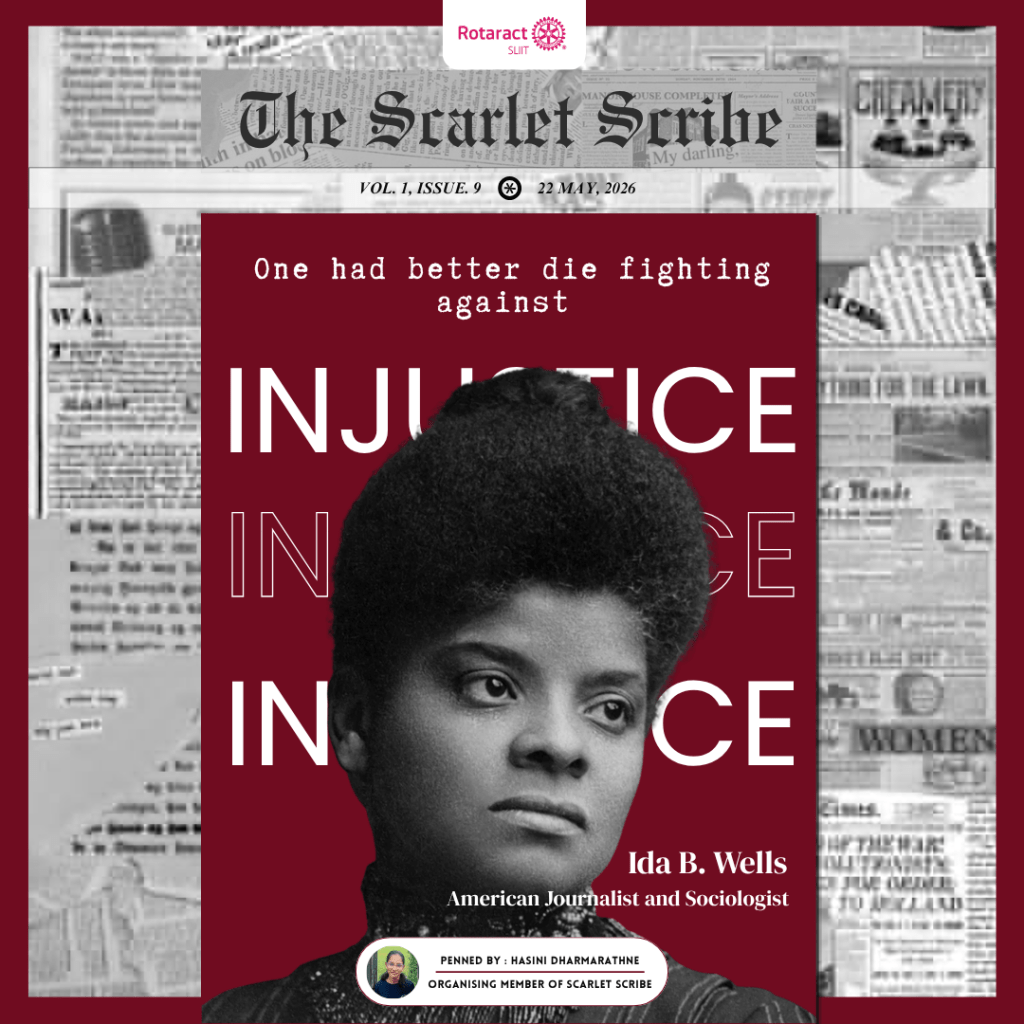
Issue 09
There are certain kinds of violence that survive because people are taught not to look at them for too long. They become buried beneath rumours, excuses, official statements, and the dangerous comfort of pretending not to know. In America during the late nineteenth century, racial violence often arrived this way: public, brutal, and yet constantly disguised by the language surrounding it.
And then there were those who insisted on documenting it anyway.
Ida B. Wells understood early that journalism was not only about recording events. It was about confronting the stories societies tell themselves in order to live with injustice. She wrote during a time when truth itself could provoke outrage, particularly when spoken by a Black woman who refused to remain quiet.
She was born into slavery in Mississippi in 1862, just months before the Emancipation Proclamation would begin reshaping the country around her. But freedom, as Ida B. Wells would learn, did not arrive cleanly or equally. Much of her early life was marked by responsibility and loss. After the deaths of her parents during a yellow fever epidemic, she became responsible for her younger siblings while still very young herself. Before she became nationally known as a journalist, she was simply a woman trying to survive in a country determined to make survival difficult.
Perhaps that is what gave her writing its sharpness. She understood injustice not as an abstract political issue, but as something that entered homes, interrupted futures, and permanently altered ordinary lives.
As a journalist, Ida B. Wells became known for investigating lynching in the American South at a time when many newspapers either ignored the violence entirely or justified it through distortion and racist propaganda. Lynchings were often defended publicly through carefully constructed lies, presented as necessary punishments rather than acts of terror. Wells refused to accept those narratives at face value.
Instead, she investigated.
She travelled, interviewed witnesses, examined records, and documented patterns others preferred not to see. She understood that evidence mattered. That statistics mattered. That names mattered. Her reporting exposed how accusations used to justify racial violence were frequently fabricated or exaggerated after the fact. In doing so, she challenged not only individual acts of brutality, but the entire system of silence protecting them.
Others repeated rumours. Ida B. Wells questioned them.
And for that, she became dangerous.
The backlash against her work arrived swiftly. After publishing investigations condemning lynching, a mob destroyed the offices of her newspaper, ‘Free Speech’, forcing her to leave Memphis for her own safety. Threats followed her work constantly. But even exile did not silence her. If anything, it widened her reach. She continued writing, lecturing, and organizing, carrying her investigations beyond the places that tried to bury them.
There is something remarkable about the steadiness with which she worked. Her writing was never driven purely by outrage, though she had every reason to feel it. Instead, she wrote with discipline, precision, and an almost relentless insistence on documentation. She understood that injustice survives easily in environments where facts are obscured, softened, or forgotten.
So she refused to let them be forgotten.
Over time, Ida B. Wells became more than a journalist. She became one of the earliest voices of investigative reporting used in direct confrontation against systemic violence. Long before the language of civil rights movements became widely recognized, she was already insisting that journalism had a responsibility beyond observation. It had the responsibility to challenge power.
Her work continues to echo through every journalist who investigates despite intimidation, every writer who documents what others wish hidden, every witness who understands that silence can become its own form of complicity.
History remembers Ida B. Wells not because she wrote comfortably but because she wrote courageously. She forced society to confront truths it desperately wanted to look away from.
And even now, her words remain, steady, uncompromising, and unwilling to let injustice disappear quietly into silence.
Penned By:
Rtr. Hasini Dharmarathne
Organising Member of Scarlet Scribe


Leave a comment