
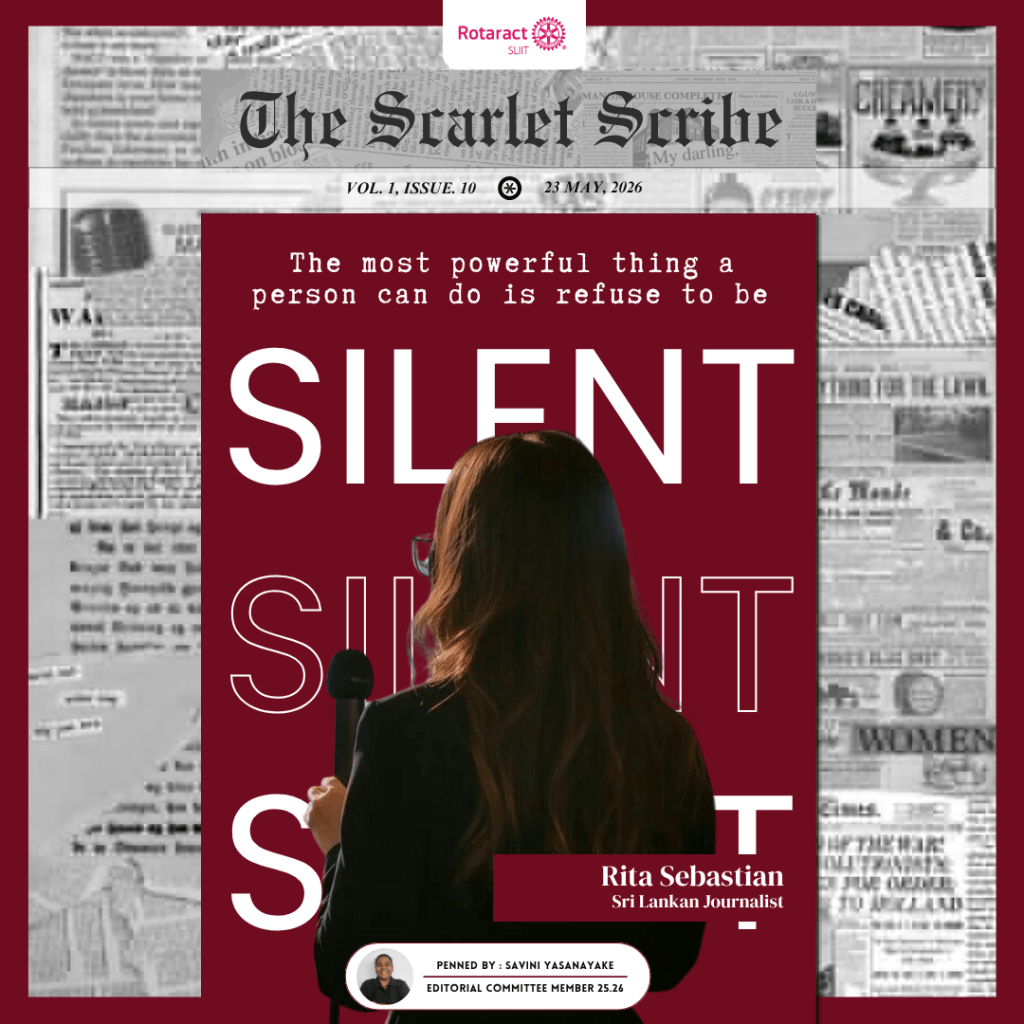
Issue 10
Rita Sebastian was the first Sri Lankan woman to edit a major newspaper. But her real revolution happened in the field, in conflict zones where very few journalists, let alone women, dared to go.
In a country tearing itself apart where the north bled through the Eelam Wars and the south burned through the youth insurgencies of the late 1980s, most people were moving away from the fire. Rita Sebastian was moving toward it. Notebook in hand. Byline on the line. She went anyway.
She reported from the frontlines of some of the most dangerous periods in Sri Lanka’s modern history. She covered the ethnic conflict, the Eelam Wars, the southern insurgencies – conflict zones where very few journalists, let alone women, dared to go. These were not assignments for the faint-hearted. They demanded physical courage, deep political understanding, and the willingness to look directly at violence and render it honestly for the world to see.
“She operated in spaces where very few journalists, let alone women, dared to go.” – Ceylon Today
| THE EDITOR WHO SHATTERED THE WORLD
When Rita Sebastian became editor of The Sunday Times, she made history as the first Sri Lankan woman ever appointed to lead a major newspaper. That title alone would have been enough to cement her legacy. But Sebastian understood, and her career proved, that the most important ground to break was not in the newsroom. It was in the field.
She was simultaneously a frontline war correspondent and an editor – filing dispatches for the Indian Express, Inter Press Service, and Kyodo News Agency while holding The Sunday Times to the exacting standards she set for herself. She did not choose between the desk and the danger. She held both, at once, without flinching.
| NOT CAPABILITY. POWER.
She was recognised, explicitly, as a “pioneer woman journalist who broke several male bastions in the profession.” Not one bastion – several. The editorship was the most visible. But the frontline reporting was the more radical act. Because it did not just challenge the gatekeepers of institutions. It dismantled the deeper, unspoken lie – that the most important, most dangerous, most consequential stories in this country belonged to men.
When Sebastian died in Colombo on 29 March 1996, after a brief illness, that lie had been publicly, undeniably disproven. Her career had shown, without room for argument, that the restrictions placed on women in Sri Lankan journalism had never been about capability. They had been about power. About who was permitted to tell the country’s most important stories – and who was not.
“The restrictions had never been about capability. They had been about power — about who got to tell the country’s most important stories.”
– Ceylon Today
| THE DOORS SHE LEFT OPEN
Rita Sebastian’s legacy is not only hers to carry. It belongs to every journalist in Sri Lanka who came after her – every woman who walked into a conflict zone with a recorder, every reporter who took on a story the powerful wished would go uncovered, every editor who held the line when it would have been easier to fold.
She was part of a generation that did not wait for permission. She covered the Eelam Wars when the Eelam Wars needed covering. She edited a national newspaper when national newspapers needed editing. And when she was gone, she left behind a profession that could no longer honestly claim the doors were closed – because she had already walked through them, and left them open behind her.
She showed us that the most powerful thing a person can do is refuse to be silent – and then go tell the story anyway.
Penned By:
Rtr. Savini Yasanayake
Editorial Committee Member 25.26


Leave a comment