
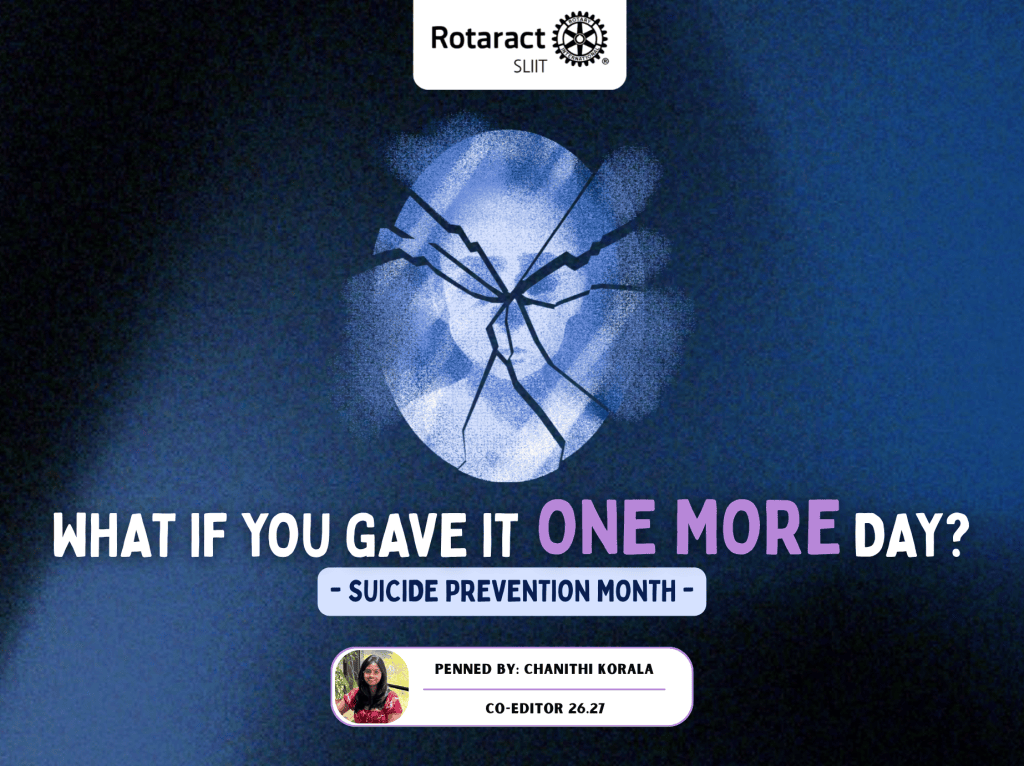
What if suicide prevention isn’t really about convincing someone to love life?
Maybe that’s where we get it wrong.
When someone is drowning, we don’t stand on the shore and explain to them how beautiful the ocean is.
We throw them a rope.
Because when pain becomes that loud,
“Life is beautiful” can sound almost insulting.
You don’t need to believe that everything will be okay.
You just need to not make a permanent decision
while you’re standing inside a temporary storm.
And maybe that’s one of the strangest things about human beings:
We can experience a feeling so completely
that our mind starts confusing
“this is how I feel”
with
“this is how everything is.”
A terrible day becomes
“my life is terrible.”
A broken relationship becomes
“I will always be alone.”
A failure becomes
“I am a failure.”
A painful year becomes
“there is no future for me.”
The mind can take a moment
and turn it into a prophecy.
But a feeling is not a forecast.
You don’t know what your life will look like
six months from now.
You don’t know who you haven’t met yet.
You don’t know what version of yourself is still waiting to exist.
And here’s the part we rarely talk about:
You don’t have to be excited about the future
to give it a chance.
You can be exhausted.
You can be angry.
You can be completely done with everything.
You can say,
“I don’t want to do this anymore,”
and still choose not to disappear.
Because sometimes staying alive isn’t a declaration of hope.
Sometimes it’s an act of uncertainty.
“I don’t know if this gets better.
But I don’t know that it doesn’t.”
And maybe that’s enough.
Maybe tomorrow doesn’t need to be amazing.
Maybe it just needs to be different.
Different weather.
A different conversation.
A different person sitting beside you.
A different morning.
One tiny thing you couldn’t have predicted from tonight.
We treat reaching out like it is asking someone to save us.
But maybe it’s actually something much simpler.
It’s handing someone a sentence
you can’t carry by yourself.
“I don’t trust my thoughts right now.”
“Please stay with me.”
“I don’t know what to do.”
And maybe the most powerful thing another person can say isn’t,
“Everything happens for a reason.”
Or,
“Think about how many people love you.”
Maybe it’s just:
“Okay.
You don’t have to figure your whole life out tonight.
I’ll stay.”
Because sometimes people don’t need someone to solve their life.
They need someone to help them survive
the hour in which their life feels impossible.
And maybe that’s what suicide prevention really is.
Not forcing someone to see the beauty in life.
Not demanding hope from someone who has none.
Not pretending pain isn’t real.
Maybe it is simply refusing to let someone’s worst moment
become the moment that defines all the moments they never got to live.
The future has a strange advantage:
It can surprise you.
The life you are certain won’t happen
hasn’t happened yet.
The person you think you’ll never become
doesn’t exist yet.
The happiness you cannot imagine
doesn’t need your permission to find you.
So maybe the question isn’t,
“Do you want to live?”
Maybe, sometimes,
the question is much smaller.
“Can we get you through tonight?”
And then tomorrow,
“Can we get you through today?”
And then one day,
you look back and realize
the life you thought had ended
was actually the life
you had not reached yet.
Maybe staying isn’t believing
that life will always be beautiful.
Maybe staying is leaving room
for life to prove you wrong.
For an awareness campaign, that “Maybe staying is leaving room for life to prove you wrong” ending is the kind of line that can really linger.
Penned by:
Rtr. Chanithi Korala
Co-editor 26.27


Leave a comment